
Nepal Trekking & Himalayan Expeditions 2027
Nepal is one of the world’s most extraordinary destinations for trekking, peak climbing, mountaineering expeditions, cultural tours and Himalayan adventure travel.
From the legendary trails of the Everest region to the remote landscapes of Manaslu, Kanchenjunga, Mustang and Makalu, Nepal offers an exceptional range of adventures for first-time trekkers, experienced hikers, technical climbers and professional mountaineers.
For 2027, travellers can choose from classic journeys such as the Everest Base Camp Trek, Annapurna Base Camp Trek, Manaslu Circuit Trek, Everest Three High Passes Trek, Langtang Valley Trek and Upper Mustang Trek, while experienced climbers can prepare for Himalayan peak climbing and major expeditions including Everest, Manaslu, Kanchenjunga, Makalu, Lhotse, Dhaulagiri and Annapurna.
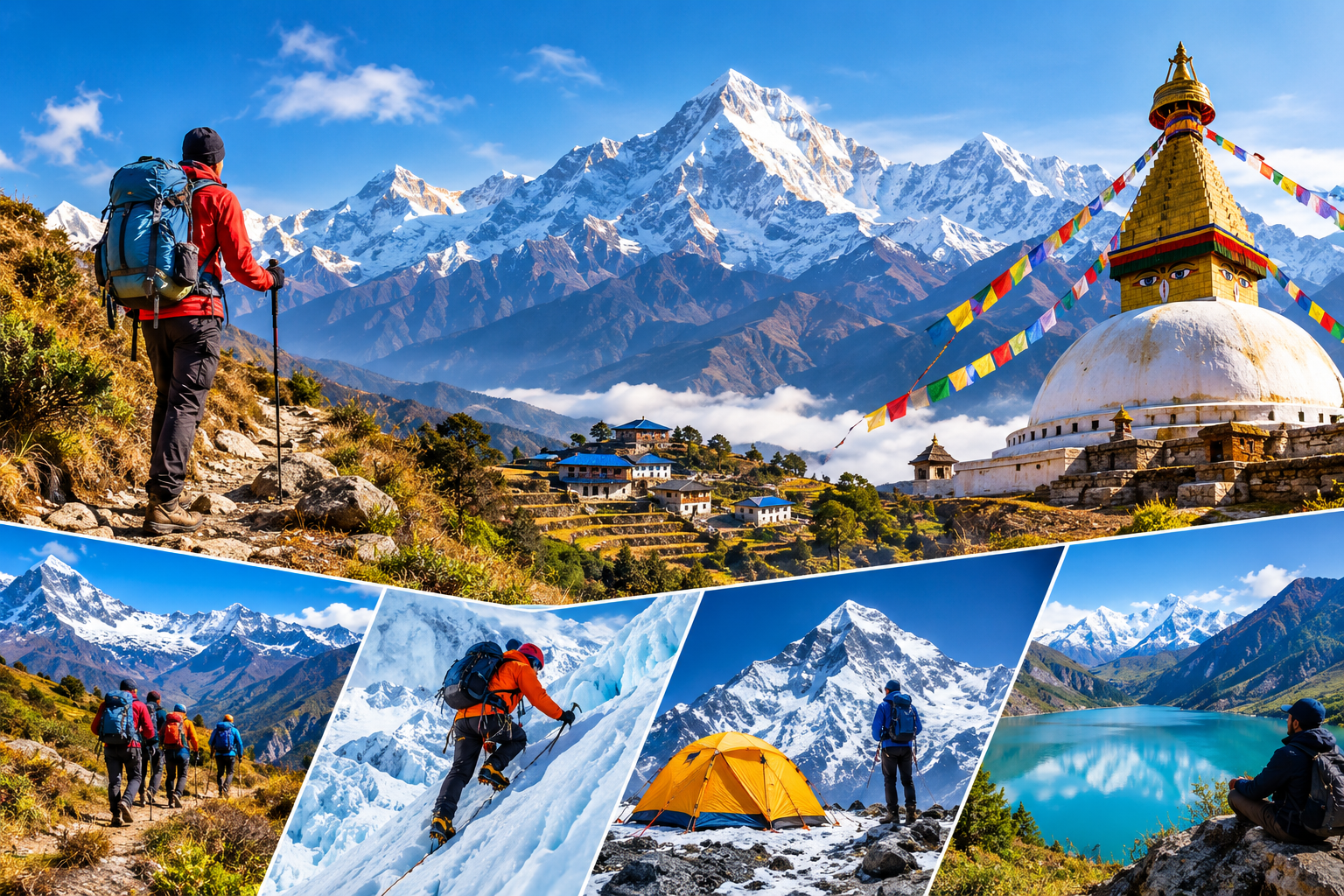
Brotherhood Adventure is a Nepal-based trekking and adventure company specialising in Himalayan trekking, peak climbing, mountain expeditions, tours and customised adventure experiences. Its current programs cover major trekking regions including Everest, Annapurna, Manaslu, Langtang and Mustang, alongside peak-climbing and expedition programs.
This guide is designed to help international travellers understand what to expect from Nepal Trekking & Himalayan Expeditions 2027, including routes, altitude, difficulty, permits, costs, seasons, preparation, safety and how to plan an adventure with a local Nepal trekking company.
Why Choose Nepal for Trekking and Himalayan Expeditions?
Nepal is internationally recognised for its exceptional Himalayan landscapes and mountaineering heritage.
Nepal is home to eight of the world’s traditionally recognised 14 eight-thousanders, located in Nepal or along its borders: Everest, Kanchenjunga, Lhotse, Makalu, Cho Oyu, Dhaulagiri, Manaslu, and Annapurna I.
This concentration of the world’s highest mountains makes Nepal a premier destination for high-altitude mountaineering.
But Nepal is not only about climbing the world’s highest peaks.
The country also offers:
- High-altitude trekking
- Himalayan camping
- Tea-house trekking
- Peak climbing
- 8,000-meter expeditions
- Mountain photography
- Cultural tours
- Village experiences
- Buddhist monastery visits
- Wildlife and nature tours
- Customised private adventures
- Multi-region Nepal itineraries
Brotherhood Adventure describes its approach as combining local knowledge, professional trip planning, experienced field teams and personalised service to create authentic Himalayan experiences.
Best Nepal Treks for 2027
Choosing the right trek depends on your available time, physical preparation, altitude experience, preferred scenery and desired level of challenge.
Here are some of the major trekking experiences offered by Brotherhood Adventure.
1. Everest Base Camp Trek
The Everest Base Camp Trek is one of Nepal’s most famous Himalayan journeys.
The route takes trekkers through the Khumbu region, where dramatic mountain landscapes combine with Sherpa villages, monasteries, suspension bridges and high-altitude valleys.
A typical itinerary includes:
- Kathmandu
- Lukla
- Phakding
- Namche Bazaar
- Tengboche
- Dingboche
- Lobuche
- Everest Base Camp
- Kala Patthar
- Lukla
- Kathmandu
The exact itinerary and duration can vary depending on acclimatisation requirements and the chosen itinerary.
Brotherhood Adventure currently lists an Everest Base Camp trekking program of approximately 15 days.
Highlights
- Everest mountain views
- Namche Bazaar
- Tengboche Monastery
- Sherpa culture
- Khumbu Valley
- Everest Base Camp
- Kala Patthar
Who is it suitable for?
The trek is suitable for travellers with good physical preparation who can comfortably walk for several hours per day at increasing altitude.
Previous trekking experience is helpful but not always essential if the itinerary is properly designed and the traveller prepares adequately.
2. Everest Three High Passes Trek
For experienced trekkers looking for a more demanding Everest adventure, the Everest Three High Passes Trek provides a much more challenging route through the Khumbu.
The classic route incorporates three major high passes:
- Renjo La
- Cho La
- Kongma La
It can also include Everest Base Camp, Gokyo Valley and Kala Patthar depending on the itinerary.
Brotherhood Adventure currently lists its Everest Three High Pass Trek at approximately 21 days.
Why choose this trek?
It combines:
- High mountain passes
- Everest region scenery
- Gokyo Lakes
- Sherpa villages
- Glacial landscapes
- Everest Base Camp
- Challenging high-altitude trekking
This trek is more demanding than the standard Everest Base Camp route and requires stronger preparation and acclimatisation.
3. Manaslu Circuit Trek
The Manaslu Circuit Trek is one of Nepal’s most spectacular high-altitude trekking routes.
The journey circles Mount Manaslu through remote Himalayan valleys and culturally rich settlements before crossing Larkya La Pass at approximately 5,106 meters.
Brotherhood Adventure currently lists a 15-day Manaslu Circuit Trek.
Major highlights
- Mount Manaslu
- Budhi Gandaki Valley
- Tibetan-influenced villages
- Buddhist monasteries
- Larkya La Pass
- High Himalayan landscapes
- Remote mountain communities
The Manaslu region is more regulated than many mainstream trekking areas, so travellers should check the latest permit and guide requirements before departure.
4. Annapurna Base Camp Trek
The Annapurna Base Camp Trek provides an opportunity to experience the Annapurna Himalayas within a relatively compact itinerary.
The route passes through villages, forests, rhododendron landscapes and increasingly dramatic mountain terrain before reaching Annapurna Base Camp.
Brotherhood Adventure currently lists a 10-day Annapurna Base Camp Trek.
Highlights
- Annapurna Sanctuary
- Machhapuchhre
- Annapurna South
- Gurung communities
- Rhododendron forests
- Mountain sunrise and sunset
It is an attractive option for travelers who want a Himalayan trekking experience without committing to a very long expedition-style itinerary.
5. Annapurna Circuit Trek
The Annapurna Circuit Trek is famous for its exceptional geographical and cultural diversity.
Depending on the selected itinerary and road conditions, travelers can experience:
- Lower Himalayan foothills
- River valleys
- Forests
- Tibetan-influenced settlements
- High alpine landscapes
- Thorong La Pass
- Muktinath
- Kali Gandaki Valley
Because road infrastructure and transportation options can change the walking itinerary, a professional itinerary should be checked before booking.
6. Langtang Valley Trek
The Langtang Valley Trek is an excellent option for travelers seeking a shorter Himalayan trekking experience close to Kathmandu.
Brotherhood Adventure currently lists an eight-day Langtang Valley Trek.
The route provides:
- Mountain scenery
- Langtang National Park
- Tamang culture
- Forest trails
- Kyanjin Gompa
- High Himalayan viewpoints
A longer itinerary can also combine Langtang with Gosaikunda.
Brotherhood Adventure currently lists a Langtang and Gosaikunda Trek at approximately 15 days.
7. Upper Mustang Trek
Upper Mustang provides an entirely different Himalayan experience.
Instead of the lush valleys associated with lower-altitude trekking, travellers encounter dry landscapes, cliffs, caves, monasteries and Tibetan-influenced settlements.
The journey can include:
- Jomsom
- Kagbeni
- Chele
- Ghami
- Tsarang
- Lo Manthang
- Ancient monasteries
- Himalayan desert landscapes
Upper Mustang is a restricted trekking area, meaning travellers must follow special permit requirements.
Brotherhood Adventure currently lists an approximately 17-day Upper Mustang Trek.
Nepal Trekking Comparison for 2027
| Trek | Duration • Maximum Altitude • General Character |
|---|---|
| Everest Base Camp | 12–16 days • 5,364 m • Iconic high-altitude trek |
| Everest Three High Passes | 18–22+ days • Over 5,400 m • Challenging high-pass adventure |
| Annapurna Base Camp | 8–12 days • 4,130 m • Moderate Himalayan trek |
| Annapurna Circuit | 12–18 days • 5,416 m • Diverse high-pass trek |
| Manaslu Circuit | 14–18 days • 5,106 m • Remote cultural trek |
| Langtang Valley | 7–10 days • Around 4,984 m* • Shorter Himalayan adventure |
| Upper Mustang | 14–18 days • Around 3,800 m • Restricted cultural trek |
*Altitude depends on the specific viewpoint and itinerary.
These durations are planning ranges rather than fixed travel times. Actual itineraries depend on acclimatisation, weather, transportation, route conditions and individual group requirements.
Nepal Peak Climbing 2027
Nepal peak climbing provides a bridge between trekking and high-altitude mountaineering.
Brotherhood Adventure currently offers programs including:
- Island Peak
- Lobuche Peak
- Pisang Peak
- Chulu Far East Peak
- Naya Kanga Peak
Island Peak Climbing
Island Peak, also known as Imja Tse, reaches approximately 6,189 meters.
It is located in the Everest region and is frequently combined with an Everest Base Camp-style approach.
Lobuche Peak Climbing
Lobuche Peak provides an opportunity for climbers to experience higher-altitude climbing in the Everest region.
The climbing itinerary involves trekking, acclimatisation, and technical climbing preparation.
Pisang Peak
Pisang Peak is located in the Annapurna region and can be combined with the Annapurna Circuit.
Chulu Far East Peak
Chulu Far East offers another Himalayan climbing objective in the Annapurna region.
Who should consider peak climbing?
Peak climbing requires more preparation than standard trekking.
Depending on the mountain, climbers may need experience with:
- Crampons
- Ice axe
- Ropes
- Ascending and descending fixed lines
- Glacier travel
- Snow and ice movement
- High-altitude camping
Brotherhood Adventure emphasises fitness, acclimatisation, appropriate equipment and technical preparation for peak-climbing journeys.
Himalayan Mountaineering Expeditions in Nepal 2027
For experienced mountaineers, Nepal offers some of the world’s most significant expedition objectives.
Brotherhood Adventure currently lists expedition programs for mountains including:
- Everest
- Manaslu
- Kanchenjunga
- Makalu
- Lhotse
- Annapurna
- Dhaulagiri
- Ama Dablam
- Cho Oyu
- Himlung
These are not ordinary trekking holidays.
A Himalayan expedition requires extensive preparation, appropriate climbing experience, specialised equipment, permits, acclimatisation, logistics and experienced mountain support.
8,000-Meter Expeditions
Nepal’s eight traditionally recognized 8,000-meter peaks include:
- Mount Everest – 8,848.86 m
- Kanchenjunga – 8,586 m
- Lhotse – 8,516 m
- Makalu – 8,485 m
- Cho Oyu – 8,188 m
- Dhaulagiri I – 8,167 m
- Manaslu – 8,163 m
- Annapurna I – 8,091 m
Brotherhood Adventure’s expedition portfolio includes these major objectives and provides expedition planning and logistical support for experienced climbers.
Everest Expedition 2027
At 8,848.86 meters, Mount Everest is the highest mountain above sea level.
An Everest expedition through Nepal generally requires a long acclimatization and expedition schedule rather than a simple trek.
Brotherhood Adventure currently lists a 64-day Everest Expedition South Col program.
A typical expedition involves:
- Kathmandu preparation
- Approach trek
- Everest Base Camp
- Khumbu Icefall
- Camp rotations
- Acclimatization
- Higher camps
- Summit attempt
- Descent
- Return to Kathmandu
The actual schedule can change because of weather, route conditions, acclimatization and expedition decisions.
Manaslu Expedition 2027
At 8,163 meters, Manaslu is the world’s eighth-highest mountain.
The mountain lies in Nepal’s Mansiri Himal and is a major Himalayan expedition objective.
Brotherhood Adventure currently lists a 36-day Manaslu Expedition.
Manaslu expedition planning requires particular attention to:
- High-altitude acclimatization
- Glacier travel
- Fixed ropes
- High camps
- Weather
- Expedition logistics
- Rescue planning
- Appropriate climbing experience
Because conditions can change rapidly, climbers must be prepared to adjust schedules according to actual mountain conditions.
Kanchenjunga Expedition
At 8,586 meters, Kanchenjunga is the world’s third-highest mountain.
The mountain is located in eastern Nepal and offers a more remote expedition environment than many better-known Himalayan routes.
Brotherhood Adventure currently lists a 50-day Kanchenjunga Expedition.
Its remote location means expedition planning and logistical coordination are particularly important.
Makalu Expedition
At 8,485 meters, Makalu is one of the world’s highest mountains.
It is known for steep terrain and technically demanding sections.
Brotherhood Adventure lists a 50-day Makalu Expedition.
Makalu is appropriate for highly experienced mountaineers who understand the physical and technical demands of extreme-altitude climbing.
Lhotse Expedition
Lhotse reaches 8,516 meters and is located directly beside Everest.
Brotherhood Adventure currently lists a 56-day Lhotse South Face Expedition.
The South Face is recognized as a particularly technical mountaineering objective, and climbers should have significant technical and high-altitude experience.
Dhaulagiri Expedition
Dhaulagiri I rises to approximately 8,167 meters and is one of Nepal’s major 8,000-meter expedition objectives.
Brotherhood Adventure currently lists a 45-day Dhaulagiri Expedition.
Its remote setting and challenging terrain make detailed expedition logistics essential.
Annapurna I Expedition
Annapurna I reaches 8,091 meters.
The mountain has an important place in Himalayan mountaineering history and remains a serious expedition objective.
Brotherhood Adventure currently lists a 45-day Annapurna Expedition.
Climbers should not confuse an Annapurna Base Camp Trek with an Annapurna I Expedition. They are fundamentally different activities requiring different levels of preparation, equipment and experience.
Ama Dablam Expedition
Ama Dablam is one of the most recognizable mountains in the Everest region.
At approximately 6,812 meters, it is not an 8,000-meter mountain, but its technical climbing character makes it a significant Himalayan expedition.
Brotherhood Adventure currently lists an approximately 26-day Ama Dablam Expedition.
Nepal Trekking Cost 2027
The cost of a Nepal trekking trip depends on several factors.
These include:
- Trek duration
- Trekking region
- Permit requirements
- Guide and porter services
- Accommodation
- Meals
- Transportation
- Domestic flights
- Group size
- Insurance
- Equipment
- Season
- Private or group itinerary
Therefore, there is no single Nepal trekking price that applies to every traveler.
Major cost categories
| Cost Category | What It Can Include |
|---|---|
| Trek Package | Guide, accommodation, meals and logistics |
| Permits | Trekking, conservation and restricted-area permits |
| Transportation | Flights, private vehicles, buses or jeeps |
| Accommodation | Kathmandu hotels and mountain lodges |
| Guide | Professional trekking support |
| Porter | Baggage transportation |
| Equipment | Rental or purchase |
| Insurance | Travel, medical and high-altitude coverage |
| Personal Expenses | Snacks, charging, Wi-Fi, tips and shopping |
For peak climbing and expeditions, costs increase substantially because of permits, specialized equipment, climbing support, expedition staff, base-camp logistics and longer durations.
For an accurate 2027 quotation, travelers should request a route-specific itinerary rather than relying on a generic online price.
Nepal Trekking Permits and Regulations
Permit requirements depend on the trekking region.
Travellers may need:
- Trekking permits
- TIMS-related documentation
- National park entry permits
- Conservation-area permits
- Restricted-area permits
- Peak-climbing permits
- Mountaineering expedition permits
Requirements can change, so travellers should verify the current rules before departure.
This is particularly important for restricted areas such as Manaslu and Upper Mustang.
Brotherhood Adventure assists travellers with practical planning and permit arrangements as part of its trekking and expedition services.
Best Time for Nepal Trekking and Expeditions in 2027
Nepal has several trekking seasons, but conditions vary significantly by altitude and region.
Spring: March to May
Spring is one of the major Himalayan trekking and climbing seasons.
Typical advantages include:
- Warmer temperatures
- Rhododendron blooms
- Increasingly favorable mountain conditions
- Major expedition activity
For high-altitude expeditions, conditions still need to be evaluated continuously.
Autumn: September to November
Autumn is traditionally one of Nepal’s most popular trekking seasons.
Travellers often choose this period because of:
- Clear mountain views
- Generally stable weather
- Comfortable trekking temperatures
- Good trail conditions
Popular routes can become busy during peak periods, so early planning is useful.
Winter: December to February
Winter can provide clear mountain views but brings colder conditions and possible snow at higher elevations.
Lower-altitude treks may remain practical, while high passes and high-altitude routes can become more challenging.
Monsoon: June to August
The summer monsoon brings substantial rainfall to many parts of Nepal.
However, some Himalayan regions lying in rain-shadow areas can remain attractive during this period.
Upper Mustang and parts of Dolpo are often considered for monsoon-season trekking because of their geography.
Travel conditions should always be checked before departure.
Nepal Trekking Weather and Altitude
Mountain weather cannot be predicted solely from city-level forecasts.
Temperature generally decreases with altitude, while wind, snowfall, cloud, rain and visibility can change quickly.
For high-altitude travel, preparation should include:
- Layered clothing
- Waterproof shell
- Warm insulation
- Gloves
- Hat
- Appropriate trekking boots
- Sleeping bag where required
- Sun protection
For expeditions, the equipment list becomes considerably more technical.
Altitude Acclimatization
Acclimatisation is one of the most important components of Himalayan trekking.
As altitude increases, the amount of available oxygen decreases.
A well-designed itinerary should therefore include appropriate acclimatisation and rest periods.
Common altitude-related symptoms can include:
- Headache
- Fatigue
- Dizziness
- Nausea
- Loss of appetite
- Difficulty sleeping
Travellers should never ignore worsening symptoms.
The appropriate response to serious altitude illness can include stopping ascent and descending, depending on the circumstances.
Professional guides can help monitor travellers and coordinate appropriate responses.
What to Pack for Nepal Trekking in 2027
Your equipment should match the route.
Clothing
- Moisture-wicking base layers
- Fleece layer
- Down or insulated jacket
- Waterproof jacket
- Trekking trousers
- Warm gloves
- Hat
- Sun hat
Footwear
- Broken-in trekking boots
- Warm socks
- Camp footwear
Personal Equipment
- Backpack
- Headlamp
- Water bottles
- Sunglasses
- Sunscreen
- Personal medication
- First-aid supplies
- Trekking poles
- Power bank
High-Altitude Equipment
Depending on the itinerary:
- Sleeping bag
- Crampons
- Ice axe
- Harness
- Helmet
- Ascender
- Mountaineering boots
- Technical clothing
Technical climbing equipment should be selected according to the specific mountain and expedition plan.
Why Travel with a Local Nepal Trekking Company?
Booking directly with a local trekking company can simplify the planning process.
A Nepal-based operator can coordinate:
- Airport transfers
- Accommodation
- Domestic transportation
- Trekking permits
- Guides
- Porters
- Mountain logistics
- Acclimatisation planning
- Emergency coordination
- Customised itineraries
Brotherhood Adventure describes itself as a locally operated Nepal adventure company with knowledge of Nepal’s mountain routes, communities, logistics and trekking conditions.
For international travelers, local support can be especially valuable when weather, transportation or mountain conditions require itinerary changes.
Why Choose Brotherhood Adventure for Nepal Trekking 2027?
Brotherhood Adventure is built around local Himalayan knowledge and personalised adventure planning.
The company currently provides trekking programs across destinations including:
- Everest
- Annapurna
- Manaslu
- Langtang
- Mustang
It also offers peak climbing and major Himalayan expedition programs.
Local Himalayan Expertise
Brotherhood Adventure’s local team understands Nepal’s trekking routes, mountain communities and practical travel logistics.
Personalized Itineraries
Not every traveller has the same fitness level, schedule or adventure objective.
Brotherhood Adventure can help customise trips around:
- Available time
- Fitness level
- Trekking experience
- Group size
- Preferred region
- Budget
- Adventure goals
Trekking, Climbing and Expeditions Under One Roof
Travellers can plan everything from a classic Himalayan trek to a technical peak climb or high-altitude expedition.
The company’s current expedition portfolio includes Everest, Manaslu, Kanchenjunga, Makalu, Lhotse, Annapurna, Dhaulagiri, Ama Dablam, Cho Oyu and Himlung.
Safety-Conscious Planning
Brotherhood Adventure emphasises acclimatisation, route planning, experienced field support and responsible mountain travel.
Authentic Himalayan Experiences
A Nepal adventure is not only about reaching a destination.
It is also about:
- Walking through mountain villages
- Meeting local communities
- Visiting monasteries
- Learning about Himalayan cultures
- Supporting local businesses
- Experiencing Nepal beyond the major tourist centres
Responsible Trekking in Nepal
The Himalayas are environmentally and culturally sensitive regions.
Travelers can help protect them by:
- Carrying reusable water bottles
- Reducing plastic waste
- Using established trails
- Respecting local customs
- Avoiding unnecessary waste
- Supporting local accommodation
- Respecting wildlife
- Following protected-area regulations
Responsible tourism benefits both travelers and Himalayan communities.
Brotherhood Adventure states that responsible travel, cultural respect, environmental awareness and support for local communities are central to its approach.
How to Choose Your Nepal Adventure in 2027
The best itinerary depends on your objectives.
Choose Everest Base Camp if:
You want to experience the world’s most famous trekking region and reach Everest Base Camp.
Choose Manaslu Circuit if:
You want a more remote Himalayan route with high-altitude scenery and strong cultural elements.
Choose Annapurna if:
You want diverse landscapes and several trekking options.
Choose Langtang if:
You have limited time and want a Himalayan trek relatively close to Kathmandu.
Choose Upper Mustang if:
You want Tibetan-influenced culture, dramatic landscapes and a restricted-area adventure.
Choose Peak Climbing if:
You want to move from trekking toward technical mountaineering.
Choose an 8,000-meter Expedition if:
You already have substantial mountaineering experience and are prepared for an extreme high-altitude objective.
Example Nepal Adventure Planning Framework
A typical international traveller can structure a Nepal adventure around four stages.
Stage 1: Choose Your Adventure
Select:
- Trek
- Peak climb
- Expedition
- Cultural tour
- Customised itinerary
Stage 2: Evaluate Your Experience
Consider:
- Fitness
- Previous altitude experience
- Technical climbing experience
- Available time
- Medical considerations
- Personal objectives
Stage 3: Build the Itinerary
Your local operator can coordinate:
- Arrival
- Kathmandu preparation
- Transportation
- Trekking
- Acclimatization
- Climbing
- Accommodation
- Departure
Stage 4: Prepare for the Himalayas
Before departure:
- Train consistently
- Purchase appropriate equipment
- Arrange suitable insurance
- Confirm permits
- Prepare travel documents
- Understand altitude risks
- Review the itinerary with your operator
Frequently Asked Questions About Nepal Trekking & Himalayan Expeditions 2027
Is Nepal good for trekking in 2027?
Nepal continues to offer a broad range of trekking and mountaineering opportunities. The specific suitability of a route depends on season, weather, regulations, transportation and individual fitness.
What is the most famous trek in Nepal?
The Everest Base Camp Trek is one of Nepal’s most internationally recognised trekking routes.
What is the best trek in Nepal?
There is no single trek that is suitable for every traveller. Everest, Annapurna, Manaslu, Langtang and Upper Mustang offer different landscapes, cultures, durations and difficulty levels.
How much does trekking in Nepal cost in 2027?
There is no universal price. Costs depend on route, duration, accommodation, permits, transportation, guide services, group size and additional services.
For an accurate 2027 price, request a customised quotation based on your preferred route.
Do I need a guide for trekking in Nepal?
Guide requirements vary according to route and current regulations. Restricted areas have specific requirements, while other routes may have additional rules introduced or updated by authorities.
Always verify the current requirements before departure.
What is the best month for Nepal trekking?
March–May and September–November are traditionally major trekking seasons, although the best period depends on the region and altitude.
Is Nepal suitable for beginner trekkers?
Yes. Nepal has trekking routes with different difficulty levels. Shorter and lower-altitude routes can be suitable for beginners, while high-pass treks and expeditions require substantially more preparation.
Can I combine trekking with a Nepal tour?
Yes.
Travellers can combine trekking with cultural and nature experiences in Kathmandu, Pokhara, Chitwan, Lumbini and other destinations.
Does Brotherhood Adventure organise customised trips?
Yes. Brotherhood Adventure states that it provides customised adventure experiences based on travellers’ interests, schedules, fitness levels, group requirements and objectives.
Does Brotherhood Adventure organise Himalayan expeditions?
Yes. Its current expedition portfolio includes Everest, Manaslu, Kanchenjunga, Makalu, Lhotse, Annapurna, Dhaulagiri, Ama Dablam, Cho Oyu and Himlung.
Plan Your Nepal Trekking & Himalayan Expedition for 2027
Your Himalayan journey should begin with the right information and the right itinerary.
Whether your goal is to walk beneath Everest, cross a high Himalayan pass, explore the remote Manaslu region, discover Upper Mustang, climb Island Peak or Lobuche Peak, or prepare for an expedition to one of the world’s highest mountains, careful planning is essential.
Brotherhood Adventure provides locally based trekking, peak-climbing, expedition and customized adventure services designed around travelers who want to experience Nepal authentically.
From your first inquiry to your return journey, the focus is on practical planning, local knowledge, responsible travel, reliable logistics and personalized Himalayan experiences.
Start Planning Your 2027 Himalayan Adventure
Tell Brotherhood Adventure:
- Your preferred travel dates
- Your desired trek or mountain
- Number of travelers
- Previous trekking or climbing experience
- Approximate trip duration
- Any special requirements
The team can then help you determine the appropriate itinerary, permits, logistics, preparation and support requirements.
Explore Nepal. Trek the Himalayas. Climb Higher. Experience More with Brotherhood Adventure.
Brotherhood Adventure
Kathmandu, Nepal
Phone: +977 986-0447967
Email: info@brotherhoodadventure.com / sherpachewa2018@gmail.com